
Your Emergency Recovery Protocol
The Great Bread Catastrophe
We have all been there. You are motoring along quite nicely, the engine is humming, the fuel lines are clean, and then you encounter a baker’s dozen of homemade bread. Or a pizza. Or a mountain of “nibbles” that were only meant to be a snack but ended up becoming a two-day residency.
I recently found myself in such a predicament. My wife – God bless her – produced a quantity of homemade bread that would have fed a small army, and I, being a man of weak resolve when confronted with warm crust and jam, decided to eat it. All of it. For two days.
The result was predictable. I wasn’t eating because I was hungry; I was eating because the “Bread Software” had taken over the hardware. I felt bloated, my sleep was a shambles, and I felt like a vintage Bentley that had been filled with cheap, low-octane kerosene. I’d broken the system. And when you break the system, you have two choices: you can spend a week “feeling bad” about it while continuing to graze, or you can pull the master power switch and perform a Hard Reboot.
Having accepted that a total system failure has occurred, we must now move from the “shame” of the bread-bin to the clinical execution of the recovery protocol.
Mission Profile: The Glycogen Flush
In a standard 16:8 or OMAD routine, your body is operating on a balanced “Cash Flow” of energy. When you binge on bread and jam, you “over-fund” your glycogen stores. You’ve filled the tanks, the spare cans, and the passenger footwells with sugar.
The 40-Hour Hard Reboot is designed to:
- Deplete the Surplus: It takes roughly 24 to 30 hours of total abstinence to burn through a massive surplus of liver glycogen.
- Reset Insulin Sensitivity: A 40-hour fast forces insulin to stay at baseline long enough for your cells to “forget” the sugar-spike and start listening to the “burn fat” signal again.
- Clear the “Sugar Bloat”: Every gram of glycogen is stored with three to four grams of water. This is why you feel like a puffed-up marshmallow. The Reboot flushes that water out.
Pre-Flight Checklist: The Operational Logic
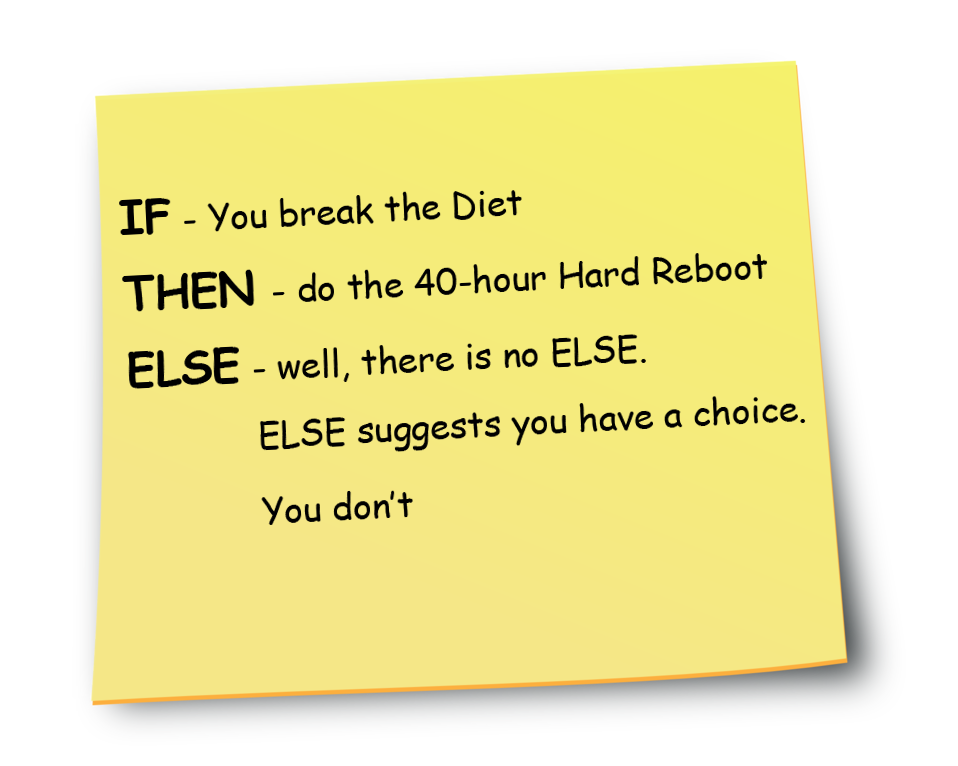
In the parlance of the programmer, the Hard Reboot is not a suggestion – it is a mandatory IF-THEN-ELSE statement that governs the entire 90-day project.
IF “you break the diet”
THEN “execute the 40-Hour Hard Reboot”
ELSE “well, there is no ELSE… ELSE suggests there is a choice, and in this system, the reboot is the only valid response to a fault.”
By viewing the protocol this way, you remove the “penance” and replace it with a Mechanical Fact.
- The Water-Salt Standard: This is a “Pure System Flush.” No broth, no coffee, no “keto-creamer.” You want the digestive tract to be completely silent.
- The Netflix Buffer: Ensure you have your “distraction suite” ready. You are going to use a shift in sleep cycles to bypass the hunger-surge.
The Build Manual: The 40-Hour Timeline
The “40-Hour” duration is specifically chosen because it spans two sleep cycles, providing the most efficient path back to Ketosis.
| Hour | Status | Action |
| 0-12 | The “Hangover” | You feel full, bloated, and guilty. Drink water. |
| 12-24 | The Transition | Glycogen is being mined. Begin the “Netflix Strategy.” |
| 24-36 | The Deep Flush | You are sleeping through the “Crux.” |
| 36-40 | The Home Straight | Mental clarity returns. The bloat is gone. |
Step-by-Step Execution
- The “Shift” Strategy: To get through the 24-hour mark without the operator interfering, utilize a shifted schedule. Binge-watch your favorite series until 4:00 AM or later. By the time the hunger hormones peak in the morning, you will be sound asleep.
- The “Long Nap”: Sleep through the daylight hours. When you wake up and see only an hour or two of daylight left, the brain naturally concludes that “there’s no point in eating now.”
- The Water Protocol: Drink only room-temperature water. If you feel a “dip” in energy, take a pinch of sea salt on the tongue. This is the only “lubricant” the system needs.
Notes from the Field: The Recovery Report
My personal observations during these “Hard Reboots” have yielded some interesting data on the senior “operator” experience. This is where the theoretical blueprint meets the practical reality of daily life.
- The Neutrality of the Fast: Unlike the initial transition to a keto diet, I no longer find a “crux” in the 40-hour fast. This is largely due to the Sleep-Shift Solution.
- The “Low-Power Mode” Strategy: To bypass the psychological triggers and the morning hunger hormones, I personally choose to alter my sleep pattern. I binge-watch engaging content until the early hours of the morning (4:00 AM or later) and sleep through the first half of the following day.
- Note for the Reader: This “shifted schedule” works for me because it removes the temptation of a daylight “lunch hour.” However, this is a User-Specific Workaround. Depending on your family commitments or work schedule, you may need to develop your own “distraction suite” – perhaps a day of gardening, a hobby in the shed, or an organized trip away from the kitchen.
- The “Badness” Erasure: Around hour 36, a profound psychological relief occurs. The feeling of being “clogged” or “guilty” is replaced by a sense of being medically cleared. You haven’t lost weeks of progress; you’ve simply performed a 40-hour maintenance cycle.
- The Stomach “Snap-Back”: The physical sensation of the stomach returning to its “pre-break” state – unbloated and calm – is the primary indicator that the reboot is successful. It is the physical signal that the IF-THEN logic has successfully cleared the “System Fault.”
The Debugging Suite (Troubleshooting)
| Symptom | Probable Cause | Corrective Action |
|---|---|---|
| Boredom/Urge to Snack | Idle Hands / Emotional Trigger | Increase Netflix intensity. Engaging “unputdownable” content is required. |
| Dizziness | Low Sodium | A pinch of sea salt immediately. Do not “tough it out.” |
| Sleep Disturbance | Adrenaline Spike | Accept the 4:00 AM bedtime. Do not fight the “Shift.” |
NSV Metrics: The Reboot Success
How do you know the “Code” is clean?
- The Vanishing Bloat: Your reflection in the mirror no longer looks like a “puffed-up” version of yourself.
- The Mental Pivot: You move from thinking about the “lost bread” to thinking about your “Target Weight.”
- The Re-entry Ease: When you finally eat after 40 hours, your appetite is controlled. The “Greed” has been flushed out.
Further Reading
The Wrap-Up: Final Verdict
The 40-Hour Hard Reboot is the ultimate tool for the senior faster who – like me – is occasionally prone to “Spousal Bread Sabotage.”
It isn’t “cheating” to use sleep as a bypass, and it isn’t “punishment” to stop eating for 40 hours. It is simply an engineering solution to a fuel-contamination problem. By hard-coding the IF-THEN statement into your brain, you remove the choice. You ate the bread? Fine. Now you execute the reboot.
I’ve done it, it works, and it’s the only way I know to stop a “one-day lapse” from turning into a “one-month collapse.” Use the Netflix strategy, use the salt, and for heaven’s sake, keep away from the jam until your 90 days are up. Now, I believe there’s a new season of The Crown that needs watching while I finish the last ten hours of my own reboot.